
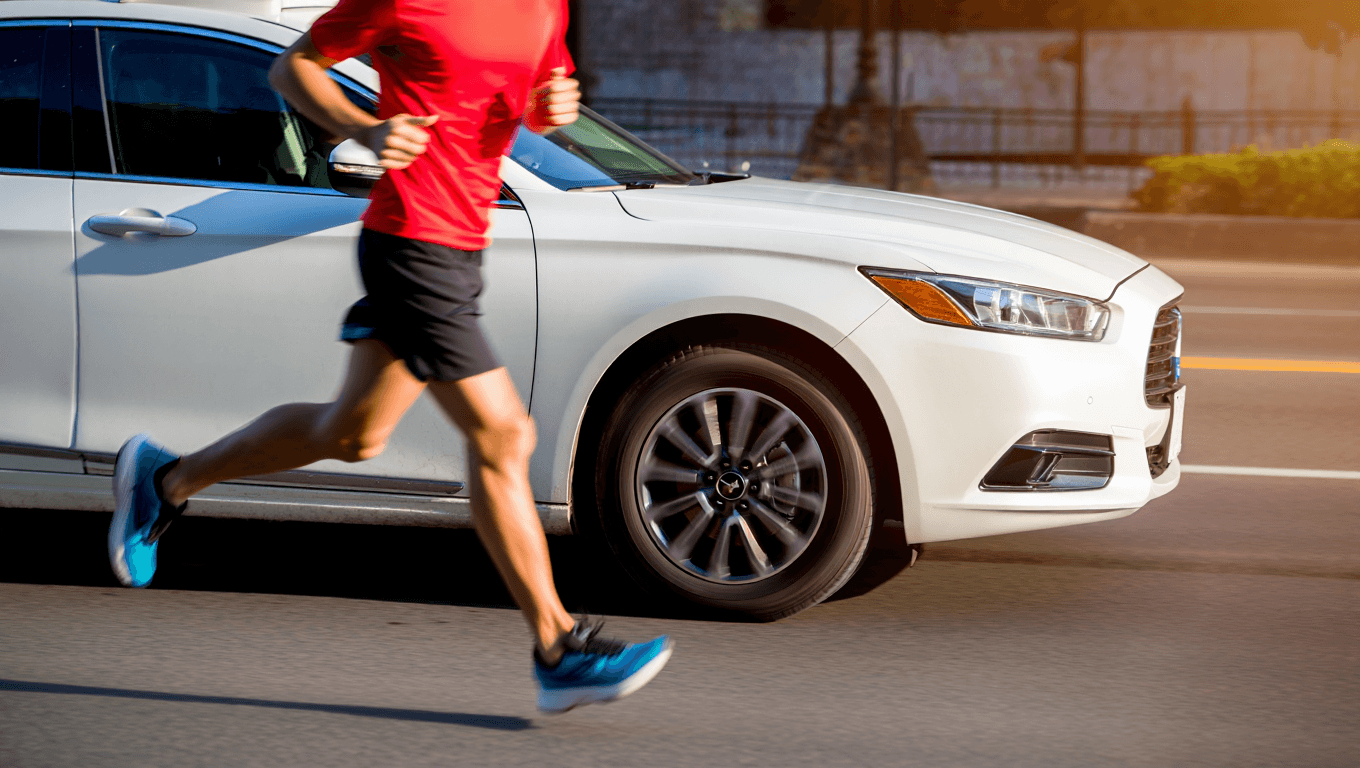
A new study warns that the next generation of self-driving cars could struggle to keep runners safe. Researchers using augmented reality found that people jogging across roads behave differently from pedestrians walking, creating a potential blind spot for autonomous systems and road planners.
Runners behave differently from walkers — and that creates risk for autonomous vehicles
Teams at the University of Glasgow and KAIST tested how runners react when approaching traffic scenarios. In virtual intersections, joggers were more likely to press on rather than stop.
Runners kept their pace and sometimes ran into the path of simulated cars. In the tests, runners collided with virtual vehicles on three occasions, while walkers avoided all contact.
Augmented reality simulations reveal how interactions break down
What the experiment set up
- Participants encountered virtual vehicles programmed to either stop or continue through junctions.
- Some cars displayed external signals to show intent.
- Researchers tracked decisions, timing and collisions for runners and walkers.
The setup let scientists measure split-second choices. Runners were less likely to decelerate or pause. That haste reduced the time available for both humans and machines to respond.
External signals helped, but complex lights confused fast movers
Vehicles in the study used two types of external human-machine interfaces to communicate with pedestrians.
Types of displays tested
- LightRing: simple red and green lights that mimicked basic stop/go cues.
- CyanBand: moving light patterns designed to indicate acceleration or deceleration.
Both walkers and runners reported that the lights clarified vehicle intentions. Still, runners struggled more with the moving patterns. The study found the simpler, direct signals were easier for fast-moving road users to process.
Researchers explain why runners act differently
One study author, a regular runner, noted that stopping while jogging adds real physical effort. That motivation to keep moving influenced how participants approached crossings.
Physical momentum and goal-directed pacing changed risk calculus for runners. They were more likely to accept tighter gaps and maintain speed when crossing.
Implications for self-driving car design and public safety
The findings raise questions for engineers and regulators working on autonomous vehicles.
- Current vehicle sensors and behaviour models may underweight fast-moving pedestrians.
- External signals need to be readable in split seconds by people who are running.
- Testing must include a range of pedestrian behaviours, not only strolling pedestrians.
Designers must consider human motivation and physical constraints, not just position and trajectory, when predicting pedestrian intent.
Policy and industry context: UK law and commercial rollouts
The UK passed the Automated Vehicles Act in 2024 to pave the way for driverless vehicles. Companies are already planning services.
- Waymo has indicated plans to launch a fully driverless taxi service in London, targeting operations by September 2026.
- Industry leaders say public trust hinges on demonstrable safety in complex, real-world interactions.
A leasing industry executive said firms must prove their systems are both effective and safe before consumers will accept autonomous taxis on busy streets.
Practical steps to reduce blind spots for runners
Researchers and safety experts suggest changes that could narrow the risk gap between walkers and runners.
- Use simpler, high-contrast external signals designed for instant comprehension.
- Equip vehicles with predictive models that detect running gait and higher velocities.
- Run city trials that include runners, cyclists and distracted pedestrians.
- Improve road markings and timing at crossings to give vulnerable users more buffer time.
Testing with diverse, realistic behaviours is essential before large-scale deployments begin.
Next steps for research and deployments of self-driving cars
Future studies will expand scenarios and refine how autonomous systems interpret human motion. Engineers will need to balance clear communication with fast reaction times.
As operator timelines approach, regulators and manufacturers must push for trials that reflect the messy reality of streets: joggers, hurried commuters and unpredictable crossings.
Similar Posts:
- Tax hikes and parking restrictions hit popular vehicles: owners brace for higher costs
- Chinese robotaxis hit London streets: inside new self-driving trials
- Electric Car Grant Alert: Millions of Drivers at Risk from EV’s Unique Dangers!
- Waymo appears to drive into exploding firework: passengers terrified
- Self-driving cars delayed in UK launch: may not be seen for some time

Naomi is a clean beauty expert passionate about science-driven skincare and natural remedies. She demystifies ingredients and shares routines that empower readers to glow — naturally.