
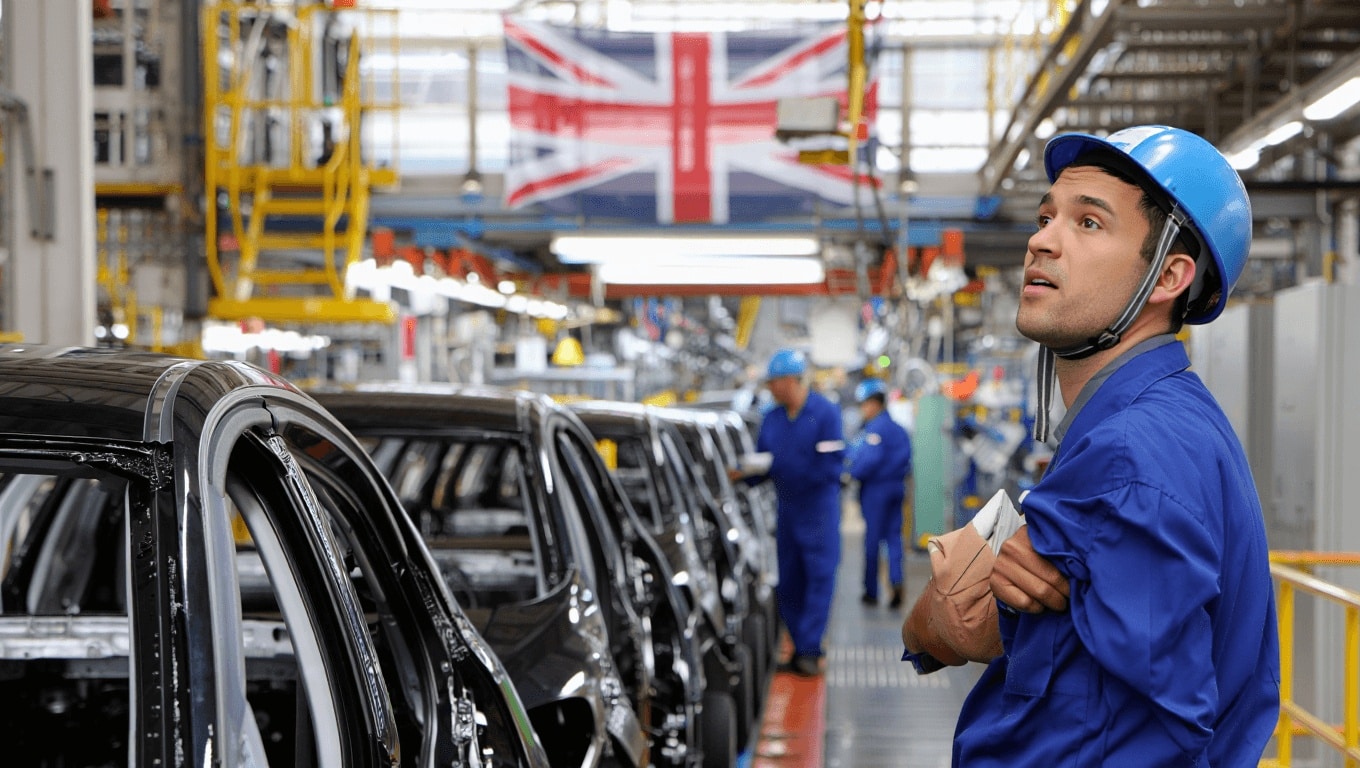
The UK car industry has hit a worrying patch. New figures for the first half of 2026 show production sliding, prompting urgent calls from manufacturers and trade bodies for faster policy action to protect jobs and keep Britain competitive in global auto markets.
Production falls: the scale of the decline in UK car manufacturing
Output of cars and commercial vehicles dropped by 7.5% in the first six months of 2026. Manufacturers produced just under 386,000 new vehicles, down from 417,000 the year before.
June alone recorded a further fall of 1.2%, underlining that the slowdown is not limited to a single month.
Exports cushion the sector but do not offset losses
Despite weaker production, the UK remains a major exporter. More than 294,000 of the vehicles built in the period were sent overseas.
Export strength keeps the UK integrated into global supply chains. Yet industry leaders warn exports cannot fully counter rising domestic costs and shrinking output.
Jobs, value and wider economic impact at risk
Trade group analysis highlights the scale of what is at stake. The automotive sector supports around 188,000 jobs and generates roughly £85 billion in turnover.
The core car-making industry adds about £18 billion in gross value added. When retail, maintenance and related services are included, the wider automotive economy is estimated at near £400 billion.
Industry leaders: urgent government measures needed
The Society of Motor Manufacturers and Traders (SMMT) and other groups say the decline is driven by weak global demand, trade friction and high costs at home.
Executives at major firms have repeatedly pointed to rising energy bills as a major hit to margins. They warn this factor could deter future investment unless addressed.
Recommended actions from the sector include:
- Cutting industrial energy costs to improve factory competitiveness.
- Reforming market regulation to reduce barriers for manufacturers.
- Securing better trading terms with global partners to protect supply chains.
- Clearing uncertainty around rules for cross‑channel trade and content rules.
Rules of Origin and “Made in Europe” proposals: a potential trade threat
The SMMT warns that proposed changes to Rules of Origin and “Made in Europe” rules could harm cross‑channel commerce.
Without mitigation, the organization says the current €80 billion trade relationship between the UK and EU is at risk.
Targets and what it would take to hit one million vehicles
Reaching the government’s ambition of producing over 1 million units annually would require roughly a 40% increase in output.
That jump is feasible in principle, the SMMT says — but only if new investment arrives and the UK becomes more attractive for global manufacturers.
Steps needed to drive growth
- Attract long-term investment into factories and supply chains.
- Lower operating costs, notably energy and regulatory compliance.
- Boost domestic sourcing to capture more value within the UK.
Opportunities identified by industry analysis
Research from the trade body points to billions of pounds in untapped domestic sourcing potential by the decade’s end.
The SMMT highlights roughly £4.6 billion of opportunity in local supply spending, if manufacturers and suppliers expand UK operations.
Recent related developments shaping the market
- Transport authorities have clashed with some brands over local emissions charges and unpaid fees.
- Changes to driving licence rules are affecting thousands of motorists and dealers.
- Carmakers warn that some new safety tech may not be fully reliable until regulations and systems catch up.
Similar Posts:
- UK car production falls: urgent action demanded to save 188,000 auto jobs
- UK car production plunges again: major brands under intense pressure
- Brexit rules to hit Britons: made in Europe plans threaten UK car sector
- Nissan warns Sunderland factory could close: existential threat from EU
- £70bn car industry at risk: Labour urged to strike deal with EU before new Brexit rules

Naomi is a clean beauty expert passionate about science-driven skincare and natural remedies. She demystifies ingredients and shares routines that empower readers to glow — naturally.